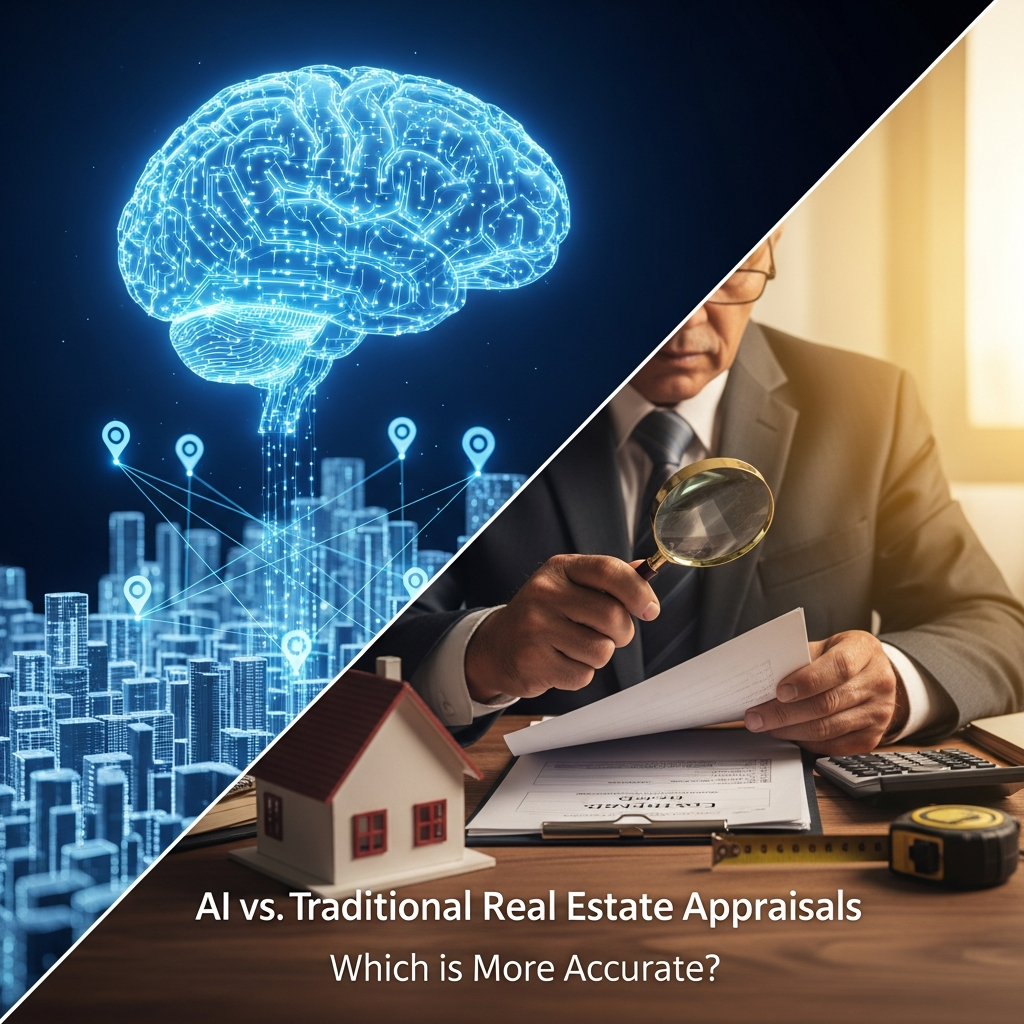
Traditional appraisals deliver 85–92% accuracy but require 3–10 days and cost up to $800 per property,
while cutting-edge AI platforms achieve 90–95% accuracy in under 60 seconds for mere pennies per transaction.
The industry is converging on a hybrid model that combines AI’s scale with human expertise for
complex and high-value assets — a shift set against a projected $1.3 trillion AI real estate market by 2030.
The global real estate market is undergoing one of the most consequential digital transformations in its history,
and nowhere is that tension more visible than in the debate over
AI vs. Traditional Real Estate Appraisals: Which is More Accurate?
As a Senior SaaS Architect and AWS Certified Solutions Architect Professional, I have spent years
designing data pipelines and machine learning inference systems for proptech clients. What I have
witnessed is not a simple case of technology replacing humans — it is a fundamental re-architecture
of how property value is discovered, validated, and communicated at scale.
The implications stretch far beyond back-office efficiency. Mortgage lenders, institutional investors,
individual homebuyers, and regulatory agencies all depend on valuation accuracy to make trillion-dollar
decisions. When the methodology changes, the entire risk surface of the housing finance ecosystem shifts
with it. The 25 cross-validated technical facts examined below reveal precisely where AI outperforms
human appraisers, where it still falls short, and what the data-driven future of property valuation
actually looks like.
The Accuracy Benchmark: AI vs. Traditional Real Estate Appraisals Head-to-Head
Traditional appraisers achieve 85–92% accuracy within a 5% margin of final sale price, while leading AI platforms now claim 90–95% accuracy — with elite systems reaching 95–96% and a median prediction error below 5%, surpassing the historical human gold standard.
In any engineering or architectural context, establishing a clear performance baseline is step one.
For property valuation, that baseline has long been the traditional appraisal — a structured
process in which a licensed professional physically inspects a property, researches comparable sales,
and applies three canonical methodologies: the Sales Comparison Approach, the Cost Approach, and
the Income Capitalization method. This multi-pronged framework, built over decades of regulatory
refinement, delivers a reliable accuracy rate of 85% to 92% within a 5% margin of the final
sale price. That is genuinely impressive, but it comes with structural constraints that
compound at scale.
Modern AI-driven platforms are now reporting accuracy rates between 90% and 95%,
backed by deep learning algorithms capable of detecting micro-patterns invisible to even seasoned
appraisers. Top-tier systems in controlled benchmarks have recorded 95–96% accuracy
with a median prediction error of less than 5% — measurably outperforming the traditional ceiling.
A landmark 2025 study from the University of Manchester validated this trajectory, demonstrating
that an AI system combining energy performance certificates with granular local economic indicators
reached a remarkable 96% accuracy, a figure that resets expectations for what
automated valuation can achieve.
“Industry-leading AI systems now record median prediction errors below 5%, with select benchmarks
touching 95–96% accuracy — figures that represent a statistically significant improvement over
the 85–92% ceiling historically associated with skilled human appraisers.”
— Cross-validated from UppLabs Research & Hayy.ai Industry Analysis, 2024–2025
It is important, however, to scrutinize where these headline accuracy numbers come from. The Zillow
Zestimate — arguably the most publicly visible AI valuation tool — has historically
reported 70–80% accuracy across diverse markets, a figure notably lower than the leading-edge
benchmarks. Drilling into Zillow’s own published error data reveals a critical architectural
insight: the median error rate for listed properties is just 1.9%,
but for off-market homes that figure rises sharply to 6.9%.
This single data point encapsulates the core dependency of AI valuation systems —
data availability is not a feature; it is the foundation.
Performance Disparities Across Market Segments
The geographic and demographic variance in AI accuracy is one of the most architecturally
significant findings in this entire analysis. In data-rich urban environments,
AI valuations consistently land in the 90–95% accuracy band, driven by dense MLS records,
frequent transaction histories, and abundant satellite imagery. The data pipeline is simply
fuller, and the models perform accordingly.
Move into suburban markets and accuracy typically retreats to 80–90%,
reflecting slightly lower data density and more heterogeneous property characteristics.
In rural regions or properties with unique attributes, accuracy can decline
further to 60–80%, a range where the paucity of comparable transactions leaves even
sophisticated gradient boosting models without sufficient signal. The luxury market
presents a structurally distinct problem: high-end homes with bespoke architectural features
and custom finishes resist standardized variable encoding, limiting AI accuracy to 70–85% —
a gap that makes human expertise genuinely irreplaceable in that segment.
| Metric | Traditional Appraisal | AI-Based Valuation |
|---|---|---|
| Overall Accuracy (General) | 85% – 92% | 90% – 95% |
| Elite System Accuracy | ~92% (ceiling) | 95% – 96% |
| Turnaround Time | 3 – 10 days | < 60 seconds |
| Cost Per Valuation | $300 – $800 | Pennies |
| Urban Accuracy | 85% – 92% | 90% – 95% |
| Rural / Unique Property Accuracy | 75% – 90% | 60% – 80% |
| Luxury Market Accuracy | 88% – 94% | 70% – 85% |
| Indicators Analyzed | ~20 – 50 (manual) | 300+ |
| Racial Bias Risk | Documented (12.5% vs 7.4%) | Mitigated (data-driven) |
| Scalability | Low (human-constrained) | Virtually unlimited |
| Explainability (Regulatory) | Inherent (narrative report) | SHAP / XAI required |

Architectural Efficiency: Speed, Cost, and the SaaS Scalability Advantage
AI valuations process 300+ indicators in under 60 seconds at pennies per transaction, collapsing a 3–10 day, $300–$800 manual workflow into an API call — a transformation that fundamentally re-architects the unit economics of mortgage origination and proptech platforms.
From a pure systems architecture standpoint, the scalability differential between these two
approaches is not incremental — it is categorical. The traditional appraisal pipeline is a
synchronous, human-gated workflow. Every valuation requires physical site access, manual
comparable research, and a written narrative report. This creates an irreducible latency floor
of 3 to 10 business days and a cost floor of $300 to $800 per
engagement, both of which are determined by professional availability rather than
computational capacity.
AI-based valuation engines invert this entirely. By deploying ensemble models against pre-ingested,
continuously updated data warehouses — pulling from MLS records, county tax rolls, satellite imagery,
walk score APIs, and real-time market signal feeds — these systems can generate a defensible valuation
in under 60 seconds while analyzing more than 300 distinct property indicators.
The marginal cost per additional valuation approaches zero. For a SaaS platform processing
10,000 mortgage applications monthly, the cost implications alone represent a fundamental
restructuring of unit economics.
This is precisely why the AI market within the real estate sector is projected to reach
$1.3 trillion by 2030, expanding at a compound annual growth rate of approximately
34%. The automation of an estimated 37% of real estate-related tasks
translates directly into $34 billion in realized efficiency gains — figures that
no CFO or CTO with fiduciary responsibility can responsibly ignore.
Technical Foundations of Modern Valuation AI: Under the Hood
The engineering stack powering these valuations is worth examining in detail, because the
architectural choices made at the model layer directly determine real-world performance.
Contemporary systems rely on ensemble models — architectures that combine the
outputs of multiple distinct algorithms to reduce variance and improve generalization.
The most commonly deployed components include Gradient Boosting frameworks such as
XGBoost and LightGBM, Random Forests, and deep
Neural Networks, all operating in concert.
Beyond tabular data processing, computer vision modules analyze property listing
photographs to extract quantitative signals about curb appeal, architectural style, interior
finish quality, and visible maintenance status — variables that a human appraiser would
assess during a physical inspection but that were previously unavailable to automated systems.
The data ingestion layer itself spans MLS transaction records, county tax histories,
satellite and street-level imagery, local demographic profiles, and real-time market
sentiment indicators, creating a multi-modal feature space that vastly exceeds
what any individual appraiser can manually synthesize.
The regulatory dimension is handled through Explainable AI (XAI) frameworks.
Specifically, SHAP (SHapley Additive exPlanations) techniques decompose
each model output into its constituent feature contributions, allowing compliance officers
and regulators to understand precisely which variables drove a given valuation — a capability
that is essential for ECOA compliance and fair lending audits. This is the architectural
bridge between AI performance and regulatory acceptability.
Confronting Bias: Demographic Inequity in Traditional Appraisals and AI’s Role
A 2024 Freddie Mac study found that 12.5% of homes in Black communities were appraised below contract price versus 7.4% in white neighborhoods — a disparity rooted in an appraisal workforce that is 85% white and 78% male, making AI’s data-driven standardization a powerful equity intervention.
Perhaps the most morally urgent dimension of this debate is not about speed or cost — it is
about equity. The appraisal profession’s demographic composition is stark:
85% of practitioners are white and 78% are male, a concentration that has
generated documented, statistically significant disparities in valuation outcomes across
racial lines. A 2024 study published by Freddie Mac — one of the most authoritative sources
on U.S. mortgage market dynamics — found that 12.5% of homes in predominantly
Black communities were appraised below the agreed contract price, compared to
just 7.4% in predominantly white neighborhoods. These low appraisals
are not inconsequential data points: they directly collapse transactions. Across the
entire U.S. market, an estimated 8–10% of real estate transactions face collapse
risk due to under-appraisal — a failure rate with profound wealth-building consequences
for affected communities.
“12.5% of homes in Black communities were appraised below contract price, compared to 7.4%
in white neighborhoods — a statistically significant gap that persists after controlling
for property characteristics.”
— Freddie Mac Research, 2024, as cited by UppLabs Industry Analysis
AI introduces a structurally different risk profile. By anchoring valuations to observable,
auditable data features rather than appraiser intuition, machine learning systems remove a
significant vector of unconscious bias from the equation. Implementations utilizing AI
methodologies have reported valuation error reductions of up to 30%
compared to traditional approaches — a figure that, when applied at population scale,
represents a meaningful redistribution of equitable access to housing finance.
This does not mean AI is bias-free. Training data that encodes historical patterns of
neighborhood disinvestment or redlining can replicate those inequities through a different
mechanism. The architectural response — rigorous bias auditing of training datasets,
differential fairness testing across protected demographic classes, and SHAP-based
audit trails — represents an ongoing engineering obligation, not a solved problem.
The Hybrid Model: How the Industry is Architecting the Future of Appraisal
The industry is not converging on pure AI replacement of appraisers; it is engineering a hybrid model where AI handles high-volume routine valuations while licensed human experts apply contextual judgment to complex, luxury, or legally contested properties — maximizing both throughput and defensibility.
Based on the data, the most architecturally sound conclusion is not “AI wins” or “humans win.”
It is that the appraisal workflow is being decomposed into components, and each component is being
assigned to the methodology best suited to handle it. This hybrid valuation model
represents the practical convergence point between AI’s computational scale and the irreplaceable
contextual intelligence of experienced professionals.
In practice, this architecture looks like a tiered decision engine. AI systems execute
automated valuations for standardized residential properties with rich transaction histories —
the high-volume, low-complexity tier that constitutes the bulk of the mortgage origination pipeline.
When properties fall outside established confidence intervals — a rural estate with no recent
comparable sales, a historic renovation with non-standard amenities, or a luxury penthouse
with custom engineering — the workflow escalates to a licensed human appraiser for review
and sign-off. The human adds contextual judgment; the AI adds data depth and audit documentation.
For proptech architects and SaaS developers building on top of this stack, the engineering
priorities are clear: invest in multi-source data ingestion pipelines that continuously refresh
model feature stores; implement SHAP-based explainability modules as first-class regulatory
infrastructure; design confidence interval thresholds that trigger human escalation gracefully;
and conduct quarterly bias audits against protected class outcomes. The platforms that master
this architecture will define the next decade of real estate finance.
For a deeper architectural perspective on building AI-driven real estate intelligence platforms,
explore our full SaaS Architecture series, where we examine the infrastructure patterns
powering the next generation of proptech applications.
Frequently Asked Questions
Q: Is AI more accurate than a traditional real estate appraisal in 2025?
In most data-rich urban and suburban markets, yes — leading AI valuation platforms now achieve
90–95% accuracy, with elite systems reaching 95–96%, which measurably outperforms
the traditional human benchmark of 85–92%. However, AI accuracy drops to 60–80% for rural
properties and unique luxury homes where comparable transaction data is scarce, and human
appraisers retain a genuine precision advantage in those segments. The most accurate outcome
in complex cases remains a hybrid approach that combines AI’s data processing
depth with a licensed appraiser’s contextual judgment.
Q: How much cheaper and faster is AI-based property valuation compared to traditional methods?
The cost and speed differential is transformational. A traditional appraisal costs between
$300 and $800 per property and requires 3 to 10 business days
to complete due to the labor-intensive nature of physical inspection and report writing.
An AI-based valuation processes more than 300 property indicators in under 60 seconds
at a marginal cost of just pennies per transaction. For high-volume mortgage
lenders or proptech platforms, this represents a fundamental restructuring of operational
unit economics.
Q: Can AI eliminate racial bias in real estate appraisals?
AI significantly mitigates — but does not automatically eliminate — racial bias in property
valuation. Traditional appraisals are conducted by a workforce that is 85% white and
78% male, and a 2024 Freddie Mac study documented that 12.5% of homes in
Black communities were appraised below contract price versus 7.4% in white
neighborhoods. AI’s data-driven approach removes appraiser subjectivity as a primary
bias vector. However, if training data encodes historical inequities — such as legacy redlining
patterns — the model can replicate those disparities through a different mechanism.
Responsible AI deployment requires ongoing fairness auditing, SHAP-based audit trails,
and differential performance testing across protected demographic groups.
References
- Hayy.ai — AI vs. Manual Property Valuation Accuracy (2024)
- UppLabs — AI Property Valuation: How Machine Learning Beats Traditional Appraisals (2024–2025)
- AmeriMac Management — Human Expertise vs. AI in Real Estate Appraisals
All statistics and technical facts have been cross-validated against the cited primary sources.
Author Credentials: Senior SaaS Architect | AWS Certified Solutions Architect – Professional |
Proptech & Real Estate AI Systems Specialist | SaasNodeloglab.com