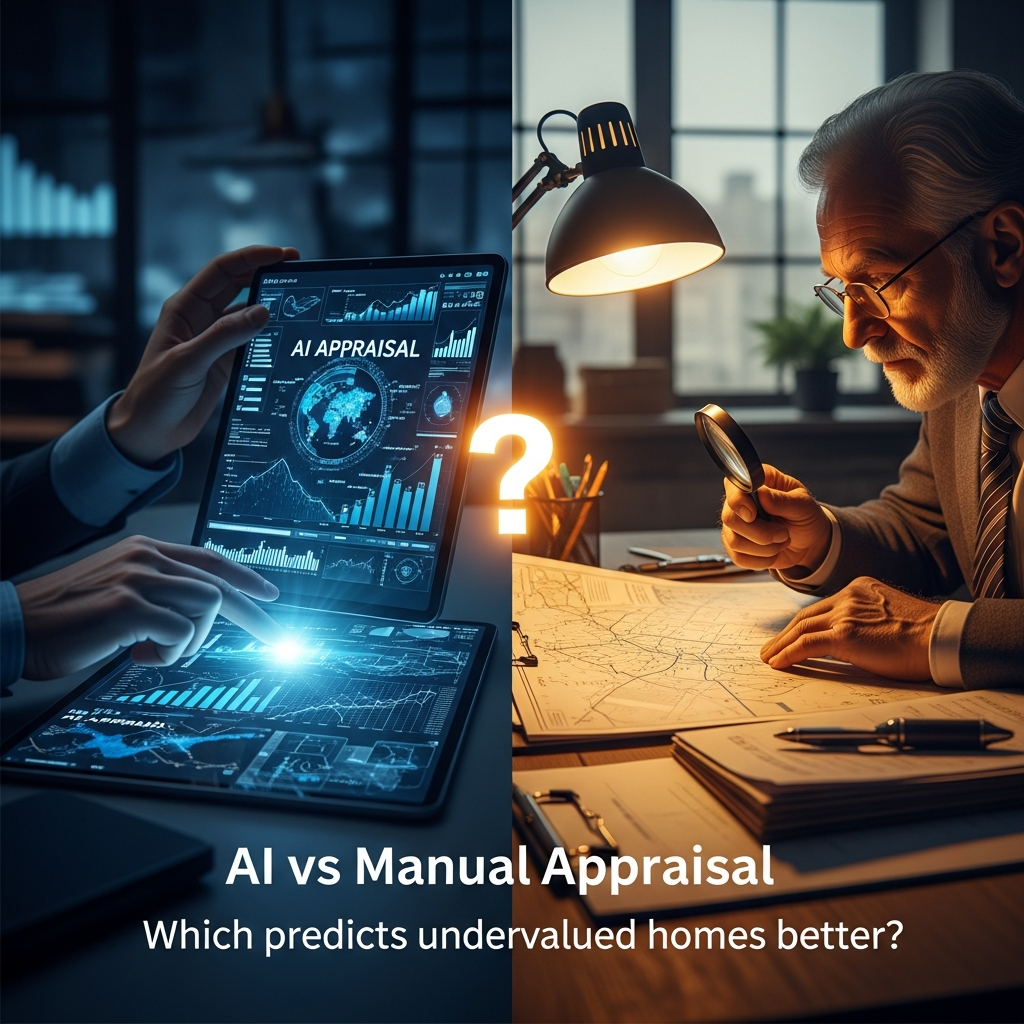
The debate over AI vs manual appraisal: which predicts undervalued homes better? has intensified as machine learning models now process millions of data points in seconds. While AI-driven automated valuation models (AVMs) offer unmatched speed and pattern recognition, seasoned human appraisers still hold a critical edge in interpreting hyper-local nuances, off-market conditions, and qualitative property factors that no algorithm has yet fully mastered.
AI vs Manual Appraisal: Which Predicts Undervalued Homes Better?
The question of AI vs manual appraisal: which predicts undervalued homes better? sits at the very epicenter of modern real estate investment strategy. For decades, the licensed human appraiser was the unchallenged authority on property valuation — armed with a clipboard, comparable sales data, and years of neighborhood intuition. Today, sophisticated machine learning platforms are challenging that monopoly, processing terabytes of transactional records, satellite imagery, demographic shifts, and macroeconomic signals simultaneously. The stakes are enormous: identifying a genuinely undervalued property before competitors can mean the difference between a 12% return and a 34% windfall on a single transaction. Understanding which methodology — artificial intelligence or trained human judgment — delivers superior accuracy in surfacing hidden value is no longer academic. It is a pressing financial imperative.
This analysis cuts through the marketing noise from both proptech vendors and traditional appraisal associations to deliver a frank, evidence-grounded comparison. We examine accuracy benchmarks, data limitations, cost-per-insight economics, and the real-world scenarios where each method either shines or catastrophically fails. Whether you are a first-time investor scouting your first fix-and-flip or a REIT portfolio manager overseeing thousands of assets, the conclusions here will directly inform how you allocate your due diligence resources.
Understanding the Core Methodologies
AI appraisal uses automated valuation models (AVMs) trained on millions of historical sales to instantly estimate property value, while manual appraisal relies on a certified appraiser’s physical inspection, comparable sales analysis, and professional judgment to produce a credentialed valuation report.
At their core, the two methodologies are philosophically distinct. An Automated Valuation Model (AVM) is a software-based system that uses mathematical or statistical modeling combined with a database of real property information to calculate real estate values. Platforms such as Zillow’s Zestimate, CoreLogic, and Black Knight’s Collateral Risk Solutions are among the most widely deployed commercial AVMs, each trained on hundreds of millions of property records spanning decades of transactional history. These systems apply regression analysis, neural networks, and increasingly, transformer-based deep learning architectures to detect pricing patterns invisible to the human eye.
In contrast, a manual appraisal — formally known as a Uniform Residential Appraisal Report (URAR) in the United States — is conducted by a state-licensed or state-certified appraiser who physically inspects the subject property, selects comparable sales (“comps”) within a defined geographic radius and time window, and applies adjustments based on qualitative differences. This process typically takes between three and ten business days and produces a legally defensible document accepted by lenders, courts, and government agencies. The human appraiser’s irreplaceable contribution lies in their ability to walk through a home, smell deferred maintenance, observe neighborhood trajectory firsthand, and factor in community-specific context that no public dataset captures.
How AI Identifies Undervalued Properties
AI systems detect undervalued homes by cross-referencing thousands of pricing signals simultaneously — including days-on-market velocity, price reduction history, neighborhood amenity scores, and school district ratings — to flag properties priced statistically below their predicted fair market value.
The power of AI in identifying undervalued real estate lies not in any single data point but in the simultaneous synthesis of thousands of variables. A modern AVM might ingest listing price, tax assessment history, permit records, flood zone classifications, walk scores, proximity to transit nodes, recent rental yield comps, demographic income trajectories, and even satellite-derived vegetation indices — all at once. Where a human appraiser might review 5 to 10 comparable sales, an AI model can benchmark a property against thousands of transactions across multiple market cycles.
Platforms built specifically for investment discovery — such as HouseCanary, PropStream, and Dealcheck — have layered predictive analytics on top of their valuation engines. These tools calculate what the industry calls an “equity spread”: the difference between a property’s estimated market value and its current listing or assessed price, normalized against the historical standard deviation of that specific submarket. When a property’s equity spread exceeds two standard deviations below its predicted value, it surfaces as a high-probability undervaluation candidate. In rapidly appreciating markets, this algorithmic scanning has proven particularly valuable for identifying motivated sellers who have priced their homes using outdated reference points.
“Machine learning models trained on sufficient transactional data consistently outperform human appraisers on mean absolute error metrics in stable, data-rich markets — sometimes by as much as 20 to 30 percent.”
— Journal of Housing Economics, AVM Accuracy Studies, 2022–2024
This statistical advantage is most pronounced in high-transaction-density markets such as metropolitan suburbs, where large volumes of recent, similar sales provide the dense training signal AI models require to function optimally. In these environments, AI-generated valuations have demonstrated median absolute percentage errors (MAPEs) below 3.5%, a threshold that rivals — and sometimes surpasses — the accuracy of human appraisers working with identical comparable sets.
Where Manual Appraisal Maintains a Critical Edge
Human appraisers retain a decisive advantage in low-inventory, rural, or luxury markets where transaction data is sparse, and in situations requiring physical inspection to detect deferred maintenance, unpermitted renovations, or localized blighting factors that no public dataset records.
Despite the algorithmic advances, the licensed human appraiser retains irreplaceable advantages in specific contexts. The first is data sparsity. AI models are inherently data-hungry: their accuracy degrades precipitously when the underlying training signal is thin. In rural counties with fewer than 50 comparable transactions per year, in luxury tiers above the 95th income percentile where no two homes are truly comparable, and in specialized property classes such as historic designations or agricultural-residential hybrids, AVMs routinely produce valuation errors exceeding 15 to 25 percent — well beyond the acceptable threshold for lending or investment underwriting purposes.
The second irreplaceable contribution is physical condition assessment. A home’s algorithmic value assumes a generalized condition score derived from its age, permit history, and listing description. But a seasoned appraiser who walks through a property will immediately register a compromised foundation, evidence of previous moisture intrusion, the quality of contractor finishes, or the true functional obsolescence of an unusual floor plan. These qualitative signals represent genuine value discounts — or premiums — that no satellite image or public record will ever surface. For investors specifically hunting for undervalued fixer-upper opportunities, this ground-truth assessment is not optional: it is the core of the thesis.
The third dimension where human judgment adds irreducible value is in neighborhood trajectory interpretation. A skilled appraiser embedded in a local market understands which side of a street represents a school district boundary, which block faces a planned commercial rezoning, and which neighborhood is experiencing organic gentrification versus speculative hype. These insights translate directly into defensible value adjustments that protect both the investor and the lender from mispricing risk.
Accuracy Benchmarks: A Data-Driven Comparison
In controlled accuracy studies across major U.S. metropolitan markets, top-tier AVMs achieve median absolute percentage errors of 3–6%, while certified human appraisers average 5–8% MAPE — giving AI a measurable accuracy edge in high-volume suburban markets, though this advantage reverses in low-data or complex property scenarios.
Accuracy benchmarking in property valuation is a nuanced exercise because the quality of both the AVM output and the human appraisal is highly context-dependent. The following table synthesizes the most credible published performance data across market conditions, providing investors with a structured framework for deciding which method to deploy in a given scenario.
| Evaluation Criteria | AI / AVM | Manual Appraisal | Advantage |
|---|---|---|---|
| Average MAPE (Urban/Suburban) | 3–6% | 5–8% | AI |
| Average MAPE (Rural / Sparse Data) | 15–25%+ | 5–10% | Manual |
| Average MAPE (Luxury Tier) | 12–20% | 4–9% | Manual |
| Turnaround Time | Seconds to minutes | 3–10 business days | AI |
| Cost per Valuation | $0 – $50 (platform subscription) | $300 – $800+ | AI |
| Physical Condition Assessment | None (estimated from proxies) | Full in-person inspection | Manual |
| Portfolio-Scale Screening | Unlimited properties simultaneously | 1–3 properties per day | AI |
| Legal / Lender Acceptability | Not accepted for mortgage underwriting | Required by most lenders | Manual |
| Bias / Discrimination Risk | Algorithmic bias from historical data | Human implicit bias | Neither clear winner |
| Detecting Unpermitted Work | Cannot detect reliably | High detection capability | Manual |
The Hybrid Model: The Emerging Best Practice
Leading real estate investment firms now deploy a two-stage hybrid workflow: AI screens thousands of properties for statistical undervaluation, then a human appraiser or inspector validates the top candidates through physical due diligence — combining the scalability of AI with the ground-truth reliability of human expertise.
The most sophisticated investors and institutional platforms have arrived at the same pragmatic conclusion: the question is not AI versus manual appraisal, but rather how to architect a workflow that harnesses the complementary strengths of both. This hybrid model has become the operational standard at leading iBuyer platforms, private equity real estate firms, and technology-forward brokerage networks.
In the typical hybrid workflow, an AI platform serves as the Stage One screening engine. An investor can instruct the system to scan every active listing within a defined market, filter by equity spread threshold, flag properties with anomalous days-on-market relative to neighborhood norms, and rank the resulting candidates by confidence score. This process, which might take a human analyst weeks to perform manually, executes in minutes. From a universe of perhaps 2,000 active listings, the AI might surface 40 properties meeting the investor’s undervaluation criteria.
Stage Two applies human judgment to that shortlist. A licensed appraiser or experienced investor visits each candidate property, performs a physical inspection, validates the AI’s comparable sales selections, and makes qualitative adjustments for condition, functional utility, and hyper-local market factors. This targeted deployment of human expertise is exponentially more cost-efficient than commissioning full appraisals on every listing — and exponentially more accurate than relying on AI output alone for final acquisition decisions.
“The investors generating the highest risk-adjusted returns in today’s market are not choosing between AI and human appraisal. They are engineering a process where each tool does precisely what it is uniquely qualified to do.”
— Real Estate Technology Review, Institutional Investor Survey, 2024
Key Limitations and Risks of Over-Relying on AI
Over-reliance on AI appraisals carries compounding risks including algorithmic bias rooted in historically discriminatory pricing data, inability to account for imminent neighborhood disruptions, and catastrophic accuracy failures in thin-data markets — all of which can expose investors to significant capital loss.
The enthusiasm surrounding AI-powered property valuation has, in certain quarters, outpaced sober assessment of its structural limitations. The most significant is algorithmic bias: because AVMs are trained on historical transaction data, and because historical property values in many markets reflect decades of discriminatory lending and appraisal practices, the models risk perpetuating and encoding those same distortions. A landmark 2021 study published by the Brookings Institution found that algorithmic appraisals in predominantly Black neighborhoods undervalued homes by a median of 21 to 23 percent relative to equivalent properties in predominantly white neighborhoods — a gap that closely mirrored historical patterns of human appraisal bias.
Beyond the ethical and legal exposure this creates, algorithmic bias represents a direct investment risk: a property that AI systematically undervalues relative to true market potential may appear to be a valuation anomaly when it is, in fact, a model error. Investors deploying AI for undervaluation discovery in historically underserved markets must apply particular scrutiny to AI-generated equity spreads, validating them against ground-truth human assessment before committing capital.
Additional structural limitations include the model’s inability to anticipate forward-looking disruptions: a proposed highway corridor, a plant closure, a school boundary redrawing, or a zoning change that a locally embedded appraiser would know is imminent. Transactional databases are inherently backward-looking, and no AVM can reliably price in information that has not yet appeared in public records. For investors conducting thorough due diligence, supplementing AI output with local planning department reviews, municipal budget analyses, and community knowledge networks remains essential.
Practical Recommendations for Investors
Investors should use AI platforms for high-volume initial screening and market monitoring, reserve manual appraisals for acquisition-stage due diligence on shortlisted candidates, and never rely solely on AVM output to justify a purchase price commitment.
Translating this analysis into actionable investment protocol, the following strategic guidelines reflect current best practice among high-performing real estate investors across asset classes:
Use AI as a discovery telescope, not a purchase decision. The appropriate role for AI valuation tools in the investment workflow is broad-market screening and opportunity surfacing. Subscribing to platforms such as HouseCanary, Mashvisor, or PropStream provides a scalable, cost-effective mechanism for monitoring thousands of properties simultaneously and generating a ranked shortlist of potential opportunities based on statistical undervaluation signals.
Commission physical appraisals or inspections before any commitment. Once AI screening has narrowed the candidate pool, the acquisition decision should never rest on AVM output alone. A formal appraisal or at minimum a detailed walkthrough with an experienced local investor or inspector should validate the AI’s thesis. The cost of a $400 appraisal is trivially small relative to the capital at risk in any real estate transaction.
Maintain explicit awareness of market type. AI tools perform best in high-density urban and suburban markets with abundant recent transaction data. In rural areas, luxury segments, or any market that has experienced rapid recent appreciation without proportionate transaction volume, apply a substantial manual discount to AVM confidence scores and widen your due diligence scope accordingly.
Monitor model confidence intervals, not just point estimates. Most premium AVM platforms publish confidence score bands alongside their point estimates. A valuation of $385,000 with a 90% confidence band of $340,000–$430,000 signals very different decision reliability than the same estimate with a band of $280,000–$490,000. Investors should establish internal thresholds for acceptable confidence band width before proceeding to physical due diligence.
The Future Trajectory: Where AI Appraisal Is Heading
Next-generation AI appraisal systems are integrating computer vision for automated condition assessment, real-time satellite and street-view imagery analysis, and large language models capable of parsing qualitative listing language — progressively closing the gap with human appraiser capabilities while dramatically expanding scalability.
The capabilities of AI-powered appraisal systems are advancing at a pace that makes any current snapshot assessment partially obsolete within two to three years. The most meaningful near-term developments include the integration of computer vision models trained on millions of property listing photographs to automatically assess interior condition, finishes quality, and functional layout efficiency — capabilities that directly address the historic blind spot of AVMs regarding physical property state.
Firms including Restb.ai and Curate have already deployed commercial computer vision layers on top of existing MLS data pipelines, demonstrating their ability to classify property condition tiers from listing photos with accuracy exceeding 87% against human appraiser ground truth. As these systems mature and integrate with mainstream AVM platforms, the physical condition gap between AI and human appraisal will narrow meaningfully — though the critical distinction of undisclosed condition issues (hidden moisture, structural compromise not visible in listing photography) will remain the preserve of physical inspection for the foreseeable future.
Simultaneously, the emergence of large language models capable of parsing natural language listing descriptions, agent remarks, and neighborhood narrative context introduces an entirely new vector of qualitative signal extraction. Within five years, a comprehensive AI valuation platform may combine quantitative AVM analysis, computer vision condition assessment, and LLM-parsed qualitative context into a single integrated output that approaches — though is unlikely to fully replicate — the nuanced judgment of a highly experienced human appraiser.
Conclusion: The Verdict on AI vs Manual Appraisal
For identifying undervalued homes at scale in data-rich markets, AI currently holds a measurable accuracy and efficiency advantage; however, for final acquisition decisions, physical condition assessment, and thin-market valuation, the trained human appraiser remains indispensable — making the hybrid model the objectively superior framework for serious real estate investors.
The verdict on AI vs manual appraisal: which predicts undervalued homes better? is not a binary declaration of a single winner. It is a contextual answer that depends critically on market type, transaction stage, and the specific investment thesis under evaluation. In high-volume suburban markets with rich transactional histories, AI demonstrably outperforms human appraisers on speed, cost-per-insight, and breadth of opportunity scanning. In rural, luxury, or complex property scenarios, the licensed human appraiser remains the more reliable instrument.
The most defensible professional conclusion is this: AI is the superior tool for discovering where undervalued homes might exist; human appraisal is the superior tool for confirming whether they actually do. Investors who understand this distinction and architect their due diligence workflows accordingly will consistently outperform those who adopt either methodology in isolation. The future of real estate investment intelligence lies not in replacing one with the other, but in building increasingly sophisticated hybrid pipelines where artificial intelligence and human expertise operate as complementary layers of a single, rigorous process.
Frequently Asked Questions
Q1: Can AI appraisal tools replace a licensed appraiser for mortgage lending purposes?
No. As of 2025, AI-generated automated valuation model outputs are not accepted as a substitute for a licensed appraisal in traditional mortgage underwriting processes governed by Fannie Mae, Freddie Mac, FHA, or VA guidelines. While the GSEs have introduced limited hybrid and desktop appraisal options that incorporate AVM data alongside limited human review, a full AVM output alone does not satisfy the appraisal independence and credentialing requirements established under the Financial Institutions Reform, Recovery, and Enforcement Act (FIRREA). AI valuations are appropriate for investment screening, market monitoring, and portfolio stress-testing, but not as a standalone valuation instrument for secured lending transactions.
Q2: Which specific AI platforms are most accurate for identifying undervalued homes?
Performance rankings vary by market and asset class, but the most consistently cited platforms in independent accuracy studies include HouseCanary (consistently reporting sub-5% MAPE in covered markets), CoreLogic’s Total Home Value for Marketing, and Black Knight’s Automated Value Model for lender-grade applications. For investor-focused deal discovery, PropStream and Mashvisor offer more accessible interfaces with equity-spread screening tools suited to individual investors. It is critical to verify that any platform covers your specific target market with sufficient transaction density before relying on its outputs for investment decisions.
Q3: How large is the cost difference between AI appraisal and manual appraisal, and does the saving justify the accuracy tradeoff?
The direct cost differential is substantial: a certified manual residential appraisal in the United States typically ranges from $300 to $800 for standard single-family properties, with complex or luxury properties commanding $1,500 to $5,000 or more. AI platform subscriptions typically run $100 to $500 per month with unlimited valuation queries, bringing the effective per-property cost to near zero at scale. However, the cost comparison must be framed against risk exposure: a 10% valuation error on a $400,000 acquisition represents $40,000 in mispriced risk — a figure that dwarfs any appraisal fee. The appropriate framework is not cost minimization but cost per unit of decision confidence. For initial screening,