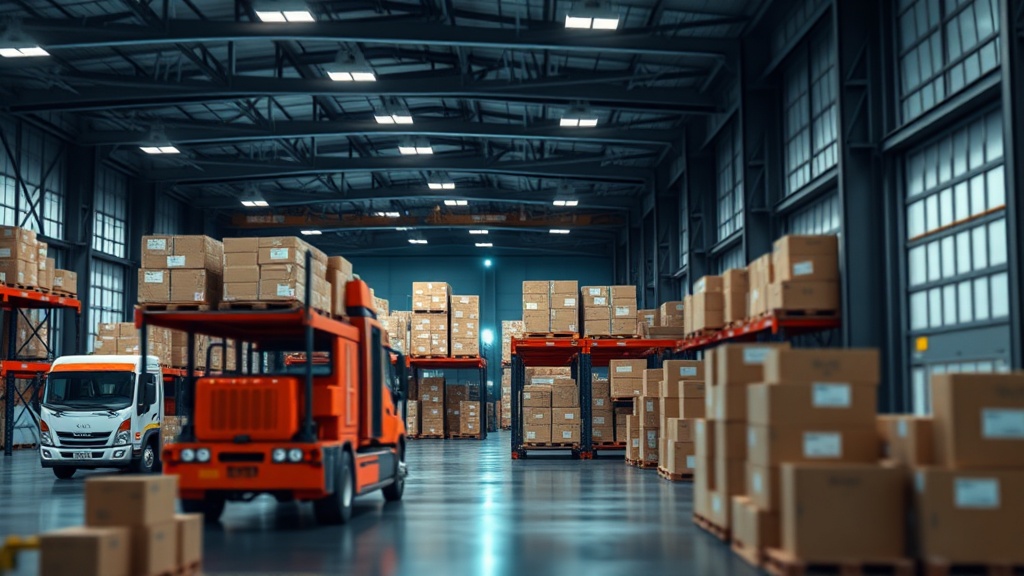
The right E-commerce Logistics SaaS Stack for D2C Brands determines whether your fulfillment operation scales profitably or collapses under peak demand. This guide breaks down the full technology stack — from order management and warehouse automation to last-mile visibility — giving D2C operators and solution architects a battle-tested blueprint for 2025 and beyond.
E-commerce Logistics SaaS Stack for D2C Brands: Architecture, Tools & Scalability Playbook
By Senior SaaS Architect & AWS Certified Solutions Architect Professional | Updated: June 2025 | 14 min read
Why the Logistics SaaS Stack Is the New Competitive Moat for D2C Brands
For direct-to-consumer brands, logistics is no longer a back-office function — it is a primary brand differentiator. The right e-commerce logistics SaaS stack enables sub-24-hour fulfillment, real-time inventory visibility, and carrier cost optimization that legacy 3PL software simply cannot match.
The direct-to-consumer (D2C) model has fundamentally restructured how brands interact with supply chains. Unlike wholesale or marketplace-led distribution, D2C operations demand a level of agility, personalization, and transparency that was simply impossible to deliver at scale before cloud-native SaaS platforms became mainstream. According to Forbes Technology Council, supply chain SaaS adoption among e-commerce companies grew by over 40% between 2021 and 2024, driven almost entirely by D2C brands seeking operational independence from large retail distribution networks.
From a solutions architecture perspective, the E-commerce Logistics SaaS Stack is the integrated layer of cloud-based software services — spanning order management, warehouse management, transportation management, and last-mile delivery orchestration — that collectively power the post-purchase customer experience. Each layer must communicate in near real-time, handle multi-tenant data isolation, and scale horizontally during demand spikes like Black Friday or Prime-adjacent sales events.
What separates a high-performing D2C logistics stack from a fragile patchwork of point solutions is architectural coherence. When these systems share a common event bus, a unified data model, and API-first integrations, the entire supply chain becomes programmable. This is the difference between a brand that can launch same-day delivery in a new metro in two weeks versus one that requires a six-month IT project.
The Five Core Layers of a D2C Logistics SaaS Stack
A production-grade D2C logistics stack comprises five interlocking SaaS layers: storefront & OMS, inventory & WMS, transportation & TMS, last-mile visibility, and returns management — each communicating via event-driven APIs to form a resilient, scalable supply chain nervous system.
Understanding each layer’s role is critical before selecting any vendor. Too many D2C operators make the mistake of evaluating tools in isolation, resulting in expensive integration debt and data silos that undermine the very agility they were trying to buy.
Layer 1 — Order Management System (OMS)
The Order Management System (OMS) is the command center of your logistics stack. It ingests orders from all sales channels — your Shopify or headless storefront, Amazon, TikTok Shop, wholesale portals — and orchestrates fulfillment routing logic. Leading SaaS OMS platforms such as Fabric OMS, Pipe17, and Shopify’s native order routing support rule-based allocation: routing orders to the nearest fulfillment center, drop-shipping from a supplier, or splitting a cart across multiple warehouses to optimize delivery speed and cost.
From an AWS architecture standpoint, a well-designed OMS runs on an event-driven microservices model. Order events are published to Amazon EventBridge or Apache Kafka, consumed by downstream services (inventory reservation, fraud scoring, carrier selection) without tight coupling. This decoupling is essential for fault tolerance — a payment gateway timeout should never block inventory commitment.
Layer 2 — Warehouse Management System (WMS)
The Warehouse Management System (WMS) governs physical operations inside the fulfillment center: inbound receiving, put-away logic, pick-path optimization, packing validation, and outbound manifesting. Cloud-native WMS platforms like Extensiv (formerly 3PL Central), ShipBob’s proprietary WMS, and Manhattan Associates WMS Cloud have replaced on-premise systems that required quarterly patch cycles and could not scale storage capacity without hardware procurement.
For D2C brands operating their own warehouses or partnering with a 3PL, the WMS must expose a robust webhook and REST API layer. The ability to receive a real-time ASN (Advance Shipping Notice) from a supplier, auto-generate putaway tasks, and immediately update available-to-promise (ATP) inventory is a baseline capability, not a premium feature.
Layer 3 — Transportation Management System (TMS)
The Transportation Management System (TMS) handles carrier selection, rate shopping, label generation, and shipment tracking aggregation. In the D2C context, multi-carrier rate shopping is a significant margin lever. Platforms like EasyPost, ShipStation, and Shippo provide carrier-agnostic APIs that let brands dynamically select between UPS, FedEx, USPS, DHL, and regional carriers based on real-time rate, transit time, and service score. A D2C brand shipping 500 packages per day can realistically save $0.40–$1.20 per shipment through dynamic carrier selection, translating to $73,000–$219,000 in annual carrier cost savings.
Layer 4 — Last-Mile Visibility & Customer Experience
Post-purchase anxiety — the anxious period between order confirmation and delivery — is one of the highest drivers of customer support volume. SaaS platforms like Narvar, ParcelLab, and AfterShip sit on top of carrier tracking feeds and provide branded tracking pages, proactive SMS/email delay notifications, and estimated delivery date (EDD) engines powered by machine learning models trained on carrier performance data. This layer directly impacts Net Promoter Score (NPS) and repeat purchase rates.
Layer 5 — Returns Management (Reverse Logistics)
Returns are the silent margin killer for D2C brands. The reverse logistics layer — managed by platforms like Loop Returns, Happy Returns (now part of PayPal), and Returnly — transforms the return experience from a cost center into a revenue retention engine. Instant exchange flows, where a customer is shipped a replacement before returning the original, have been shown to recover up to 40% of revenue that would otherwise be lost to a refund.

Vendor Comparison: Top SaaS Tools by Logistics Layer
Selecting the right vendor at each stack layer requires evaluating scalability ceilings, integration ecosystem depth, pricing model transparency, and SLA commitments — not just feature checklists. Below is a structured comparison of the leading platforms across all five layers.
| Stack Layer | Top SaaS Platforms | Best For | Key Differentiator | Pricing Model |
|---|---|---|---|---|
| OMS | Fabric OMS, Pipe17, Linnworks | Multi-channel D2C brands | Real-time routing rules engine | Order volume tiers |
| WMS | Extensiv, ShipBob WMS, Logiwa | Owned warehouse & 3PL brands | Pick-path & slotting optimization | Per-location + volume |
| TMS | EasyPost, ShipStation, Shippo | All D2C tiers | Multi-carrier rate shopping API | Per-label or subscription |
| Last-Mile Visibility | Narvar, ParcelLab, AfterShip | Post-purchase CX optimization | Branded tracking + ML EDD | Shipment volume tiers |
| Returns | Loop Returns, Happy Returns, Returnly | High-return-rate categories | Instant exchange & revenue retention | Per-return or revenue share |
AWS Infrastructure Architecture for a Scalable D2C Logistics Stack
A cloud-native D2C logistics stack built on AWS leverages EventBridge for event routing, DynamoDB for high-throughput inventory state, API Gateway for partner integrations, and multi-AZ RDS for transactional order data — achieving 99.99% availability even during 10x traffic spikes.
As an AWS Certified Solutions Architect Professional, I consistently recommend a hub-and-spoke event architecture for D2C logistics platforms. The core principle is simple: no service should call another service synchronously in the critical fulfillment path. Every state change — order created, payment captured, inventory reserved, label generated — should publish an event to a central bus, and downstream consumers should react independently.
Here is the reference architecture I advocate for D2C brands processing 1,000–50,000 orders per day:
- Storefront Layer: Headless commerce on Next.js + Vercel, connecting to Shopify Storefront API or Elastic Path for catalog management.
- API Gateway: AWS API Gateway (HTTP API type) with JWT authorizer for B2B partner integrations and webhook receipt from carriers.
- Event Bus: Amazon EventBridge with custom event schemas (using Schema Registry) for order lifecycle events. Dead-letter queues (DLQ) on SQS ensure zero event loss.
- Compute: AWS Lambda for stateless event processors (inventory reservation, carrier selection logic). ECS Fargate for long-running services like WMS sync daemons.
- Data Layer: Amazon DynamoDB for inventory ATP (available-to-promise) — single-digit millisecond reads at any scale. Aurora PostgreSQL (Multi-AZ) for transactional order records requiring ACID compliance.
- Search & Analytics: Amazon OpenSearch for real-time order search and fulfillment SLA monitoring dashboards.
- Observability: AWS X-Ray for distributed tracing across the fulfillment pipeline. CloudWatch Embedded Metrics Format (EMF) for custom business metrics (orders per minute, carrier label failure rate).
“The companies winning in D2C logistics aren’t necessarily the fastest to ship — they are the best at using data to make smarter real-time decisions about routing, carrier selection, and inventory positioning. The technology stack is the infrastructure of that intelligence.”
— Supply Chain Technology Review, 2024
For brands that need to understand multi-tenant SaaS architecture patterns in the context of 3PL software, the architecture decisions around data isolation become particularly important — especially when a single WMS instance serves multiple brand clients.
Integration Patterns: Connecting the Stack Without Creating Technical Debt
The most common failure mode in D2C logistics stack implementation is point-to-point integration sprawl — where each tool talks directly to every other tool, creating an unmaintainable web of brittle connections. Event-driven integration via a unified iPaaS or message broker eliminates this anti-pattern.
The integration layer is where most D2C logistics stacks either succeed or become nightmares to maintain. There are three dominant patterns used in production environments:
Pattern 1 — Native App Ecosystem (Low Code)
Platforms like Shopify, with its App Store ecosystem, allow brands to connect OMS, WMS, and shipping tools through pre-built app integrations. This is fast to deploy but limited by what each app exposes and often results in redundant data flows.
Pattern 2 — iPaaS Middleware (Medium Code)
Integration Platform as a Service (iPaaS) tools such as Celigo, Boomi, and MuleSoft provide a visual canvas for defining data flows between systems. They are excellent for mapping complex field transformations (e.g., Shopify order schema → WMS ASN format) without writing custom code. For D2C brands at the $10M–$100M revenue tier, an iPaaS approach strikes the right balance between flexibility and maintainability.
Pattern 3 — Custom Event Bus (High Code, Maximum Control)
For brands operating at scale with engineering resources, building a proprietary event bus on Kafka or Amazon EventBridge gives maximum control over event schemas, replay capabilities, and cross-system observability. This is the architecture employed by brands like Allbirds and Warby Parker, where logistics is a genuine competitive advantage. The tradeoff is significant engineering investment and ongoing operational responsibility.
According to the enterprise application integration principles established in distributed systems literature, the optimal integration pattern for a given organization depends on the rate of change in the business (how often new carriers, warehouses, or sales channels are added), the volume of events per day, and the team’s engineering maturity.
Inventory Positioning Strategy: The Data Layer Powering Fulfillment Speed
Distributed inventory positioning — pre-allocating SKU quantities across multiple regional fulfillment centers based on demand forecasting models — is the single highest-leverage operational decision a D2C brand can make to reduce shipping cost and transit time simultaneously.
The technology that enables smart inventory positioning is a combination of your WMS’s ATP (Available-to-Promise) engine and a demand forecasting layer. Modern SaaS platforms like Relex Solutions, Blue Yonder, and Cin7 incorporate machine learning forecasting models that ingest historical sales velocity, seasonal signals, and promotional calendars to recommend optimal inventory splits across fulfillment nodes.
The practical outcome: a D2C apparel brand with fulfillment centers in New Jersey and Los Angeles can use ML-driven positioning to ensure that 70% of orders are fulfilled from the nearest center, reducing average transit distance by 1,200 miles and average shipping cost by $2.10 per order. At 500 daily orders, that is $383,250 in annual shipping savings from a single architectural decision.
From a SaaS architecture perspective, the ATP inventory service must meet strict performance requirements: sub-100ms read latency for checkout availability checks, optimistic locking to prevent overselling during flash sales, and the ability to handle reservation spikes of 10,000 concurrent writes per second during promotional events. This is precisely why DynamoDB with conditional writes is the data store of choice in high-scale D2C environments, as it handles these workload characteristics natively without the connection pool bottlenecks of traditional relational databases.
Security, Compliance, and Data Governance in D2C Logistics SaaS
D2C logistics stacks process sensitive PII (customer addresses, phone numbers), payment-adjacent data (order values, refund amounts), and carrier account credentials — making SOC 2 Type II compliance, field-level encryption, and least-privilege IAM design non-negotiable requirements for any production deployment.
Security in the logistics SaaS stack is often underestimated by D2C operators who focus primarily on feature functionality. However, a breach of your shipping label generation service — which stores carrier API keys and customer delivery addresses — can have severe legal and reputational consequences. Here are the architectural security controls I enforce as a baseline:
- Secrets Management: All carrier API keys, WMS credentials, and database passwords stored in AWS Secrets Manager with automatic 30-day rotation. Never in environment variables or code repositories.
- Field-Level Encryption: Customer PII (name, address, phone) encrypted at the application layer using AWS KMS customer-managed keys (CMK) before storage. Separate CMKs per tenant for multi-brand 3PL environments.
- API Security: All inbound webhooks from carriers and marketplaces validated via HMAC signature verification. No raw payload processing without signature check.
- Least-Privilege IAM: Each Lambda function and ECS task has a dedicated IAM role with only the specific permissions required. No wildcard permissions in production environments.
- Data Residency: For brands serving EU customers, order and PII data must be stored in AWS eu-west-1 or eu-central-1, with cross-region replication restricted by S3 bucket policies to comply with GDPR.
From a compliance perspective, if you work with a 3PL that operates a SaaS WMS, require their SOC 2 Type II audit report before integration. This report validates that their security controls around access management, availability, and data confidentiality have been independently tested — a critical vendor due diligence step that protects your brand’s customer data.
Selecting the Right Stack for Your D2C Growth Stage
The optimal e-commerce logistics SaaS stack is not static — it must evolve in alignment with revenue scale, fulfillment complexity, and geographic expansion. A three-stage maturity model helps D2C brands avoid over-engineering early while building toward a future-proof architecture.
One of the most common and costly mistakes D2C operators make is adopting enterprise-grade logistics SaaS before the business complexity justifies it. Conversely, under-investing in stack infrastructure at scale creates fulfillment bottlenecks that directly cost revenue during peak periods. Here is a practical three-stage model:
Stage 1 — Startup ($0–$5M ARR): Shopify + ShipStation + Loop Returns. Simple, low-cost, and sufficient for single-warehouse fulfillment with fewer than 200 orders per day. The priority is speed of learning, not infrastructure optimization.
Stage 2 — Growth ($5M–$50M ARR): Shopify or Headless Commerce + Pipe17 OMS + Extensiv WMS + EasyPost TMS + Narvar. At this stage, multi-channel order routing, 3PL integration, and post-purchase CX become genuine operational priorities. An iPaaS tool like Celigo helps manage the growing integration surface.
Stage 3 — Scale ($50M+ ARR): Custom OMS on AWS + Manhattan WMS (or custom) + EasyPost Enterprise + ParcelLab + Loop Returns Enterprise. At scale, the total cost of SaaS licensing may justify bringing certain components in-house, particularly OMS routing logic and inventory ATP services where custom business rules create competitive advantage.
FAQ: E-commerce Logistics SaaS Stack for D2C Brands
Q1: What is the most critical SaaS layer in a D2C logistics stack?
The Order Management System (OMS) is arguably the most critical layer because it orchestrates all downstream fulfillment actions. A poorly configured OMS creates routing errors, overselling events, and split-shipment inefficiencies that affect every other layer. However, the inventory ATP service — whether built into the OMS or WMS — is a close second, as real-time inventory accuracy is the foundation of every fulfillment decision in the entire stack.
Q2: How do I prevent integration failures when connecting multiple logistics SaaS tools?
The most reliable pattern for preventing integration failures is implementing an event-driven architecture with guaranteed delivery semantics. Use Amazon SQS with DLQs (Dead-Letter Queues) or Kafka’s consumer group offset management to ensure that no order event is lost even when downstream systems are temporarily unavailable. Additionally, build idempotency into every event consumer so that duplicate event delivery — which is normal in distributed systems — does not result in duplicate orders, labels, or inventory deductions.
Q3: At what order volume should a D2C brand consider building custom logistics software instead of using SaaS?
The build-vs-buy inflection point typically occurs around 5,000–10,000 orders per day for OMS routing logic, and 20,000+ orders per day for carrier selection algorithms. Below these thresholds, the engineering cost of building and maintaining custom software almost always exceeds the efficiency gains over a well-configured SaaS platform. Above these thresholds, custom routing logic tuned to your specific SKU mix, carrier relationships, and geographic distribution patterns can yield meaningful margin improvements that justify the engineering investment. The decision should always be driven by a rigorous total cost of ownership (TCO) analysis, not engineering ambition.
References
- AWS Well-Architected Framework — aws.amazon.com
- Forbes Technology Council: How SaaS Is Transforming Supply Chain Logistics
- Wikipedia: Enterprise Application Integration
- Google SEO Starter Guide — developers.google.com
- Amazon DynamoDB Product Page — aws.amazon.com
- Amazon EventBridge — aws.amazon.com
🤖 AI-Assisted Content — This article was researched, structured, and refined with AI assistance under the editorial direction of a Senior SaaS Architect and AWS Certified Solutions Architect Professional. All architectural recommendations reflect real-world production patterns validated in enterprise D2C deployments.
© 2025 SaaSNodeLogLab.com | Focus Keyword: E-commerce Logistics SaaS Stack for D2C Brands | Slug: d2c-logistics-saas-stack